The known history of the château goes back to the year 1005. It was a fortified house surrounded by a moat with two drawbridges, four square towers and a keep. Built on Burgundian ruins, which had themselves been built on Roman remains, the château burned down around the year 1600. Taking advantage of peace and security, part of the fortifications was used to enlarge the living quarters.
Having belonged to the Counts of Savoy and to several families, it passed into Bernese hands for eight generations with the de Tavel family, then by marriage, in 1796, to the de Buren family. My sons, Félix and Youri de Buren, are the seventh generation to live at the château.
A thousand years of history
1005First mention of Denens, “Disnens”: a fortified house, a chapel, rooms and vineyards are already listed. The village celebrated its thousandth anniversary in 2005.
11th centuryVines are grown in Denens.
1177The church, dedicated to Saint Lazarus, is a parish church under the monks of the Great St Bernard. The present church dates from the 15th century.
Until 1300Denens is part of the lands of the lords of Vufflens-le-Château (the de Duin family).
1300Richard de Duin exchanges Denens for the village of Bussy: the estate passes to the House of Savoy.
Around 1360Count Amadeus VI of Savoy owns the château, which the House of Savoy transforms and fortifies. It then passes to Marguerite d’Oron.
1370 – 1531The de Compey family are the lords of Denens.
16th centuryJeanne Curnillon: her coat of arms, a crow on a hill, would inspire the village’s coat of arms in 1920.
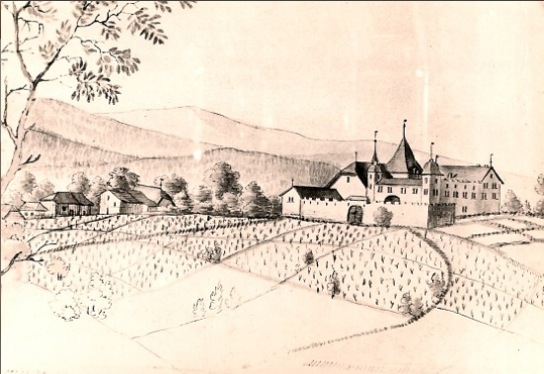
Around 1600The château burns down. With peace and security restored, part of the fortifications is used to enlarge the living quarters: the fortified house becomes a residence that has hardly changed since.View of the fortified house of Disnens (Denens) before the fire of 1600
1666The Bernese painter Albrecht Kauw depicts the château surrounded by its vineyards in a watercolour, after a sketch by Johannes Dünz.
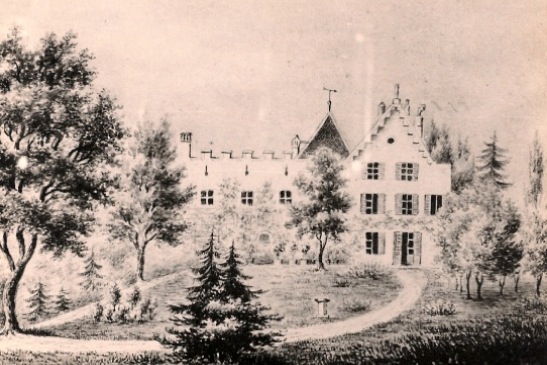
Bernese periodThe de Tavel family owns the château for eight generations; it is altered several times while keeping large parts of the fortress.The gardens and the south façade in the 18th century
1796Marianne de Tavel marries Louis de Buren: the château passes to the de Buren family, who still live there today.
1802Revolt of the Bourla-Papey (“paper burners” in the local dialect). From February to May, Vaud peasants, furious at the reinstatement of feudal dues, stormed the châteaux to burn the registers recording their debts to the lords. The archives of La Sarraz, Bière, Morges, Rolle and Yverdon went up in smoke. The movement won its case: on 29 September 1802, feudal rights were abolished. The château of Denens was also visited by the insurgents.
Early 20th centuryAlfred de Buren, great-grandfather of the present owner, turns part of the fields into vineyards.
2014The estate converts to organic farming (Bio Suisse).
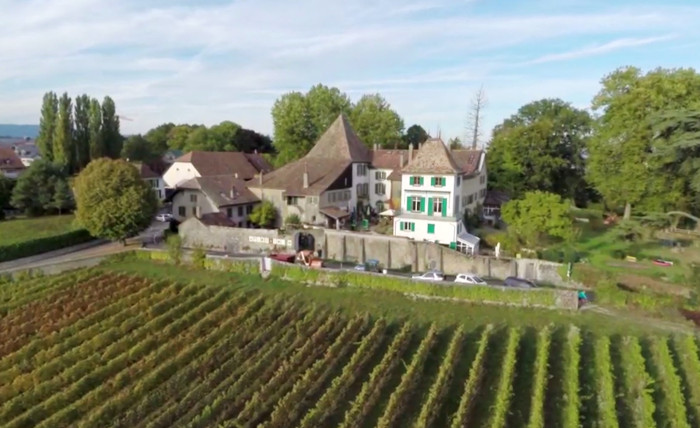
TodayFélix and Youri de Buren are the seventh generation to live at the château. The estate produces organic wines and honey, welcomes guests in its rooms and hosts events.The Château today
Anecdotes
Napoleon and the bailiff. Ludwig de Buren, the last Bernese bailiff of Lausanne, had recruited soldiers for France and is said to have helped a young officer named Napoleon Bonaparte at Toulon. Napoleon visited him in 1797 at the Château Saint-Maire in Lausanne.
The “Fouta-Renailles”. This is the nickname of the people of Denens: according to tradition, they had to beat the marshes of the Vogeaz plain to silence the frogs and let their lord sleep.
A disputed coat of arms. Created in 1920 for a medal given to mobilised soldiers, the coat of arms of Denens is based on arms found at the château. There was long debate: blackbird or crow? The crow won.
World capital of the scarecrow. In 1995, the winegrowers held the first scarecrow festival. Following its success, Denens proclaimed itself the “World Capital of the Scarecrow”, a title no one has ever challenged.
Never besieged. Despite its fortifications, the château is said never to have suffered a siege or a military attack.
The vineyard
Vines have been grown in Denens since the 11th century: the document of 1005 already mentions vineyards around the fortified house, and Albrecht Kauw’s watercolour shows the château surrounded by vines in the 17th century. In the early 20th century, Alfred de Buren replanted part of the fields with vines; Pierre de Buren then modernised the estate and its production methods, leading to the switch to organic farming in 2014. Today, Chasselas, Pinot Noir, Merlot and our specialities can be tasted at the château’s wine cellar.